
RishteGhar · Clear, practical information
Groom Biodata Format for Marriage
A groom’s biodata is a one-page summary of a man’s basic details, education, work, family and contact information. This page covers the marriage biodata format for male candidates and the male marriage biodata format used for men, with a fictional example you can follow.
Recommended order: Basic details → Education and occupation → Family → Contact → Partner preference (optional).
Create a groom biodataRishteGhar’s biodata maker is for adults (18 or older). A parent or family member may help prepare a biodata, but only with the adult’s consent.
A fictional annotated example
Everything below is made up. Use it as a model for structure and wording, not as content to copy.
|| Shri Ganeshaya Namaha ||
Karan Malhotra
Basic details
- Date of birth
- 5 February 1995
- Height
- 5'11" (180 cm)
- Marital status
- Never married
- Diet
- Non-vegetarian
- Place of birth
- Chandigarh
Section 1: Open with the facts: date of birth, height, marital status and diet. Keep each to a few words.
Education and occupation
- Education
- B.Com, Panjab University; CA (qualified)
- Occupation
- Chartered accountant at an audit firm, Chandigarh (6 years)
- Income
- Prefer to discuss later
Section 2: Name the degree, the field and your current role with the city and years of experience. Concrete beats “good job”.
Family
- Father
- Surinder Malhotra (own business)
- Mother
- Rekha Malhotra (homemaker)
- Siblings
- 1 younger sister (married)
Section 3: One short line each for parents and siblings. Keep to facts that help both families understand the background.
Contact
- Contact person
- Surinder Malhotra (father)
- Phone
- +91 98XXX XXXXX
- City
- Chandigarh
Section 4: Give one contact person and a phone number, and the city. Keep the full address for later.
Partner preference(optional)
- Looking for
- A caring, independent partner who values family and open conversation
Section 5: Optional. A sentence or two on what you value is enough.
Details to include in a groom’s biodata
- Full name: the name he uses, spelled correctly.
- Date of birth and height: the basics families check first.
- Education: highest qualification and field of study.
- Occupation: role, type of organisation, city and years of experience.
- Family: parents’ names and occupations, siblings and family type.
- Contact: one contact person, a phone number and the city.
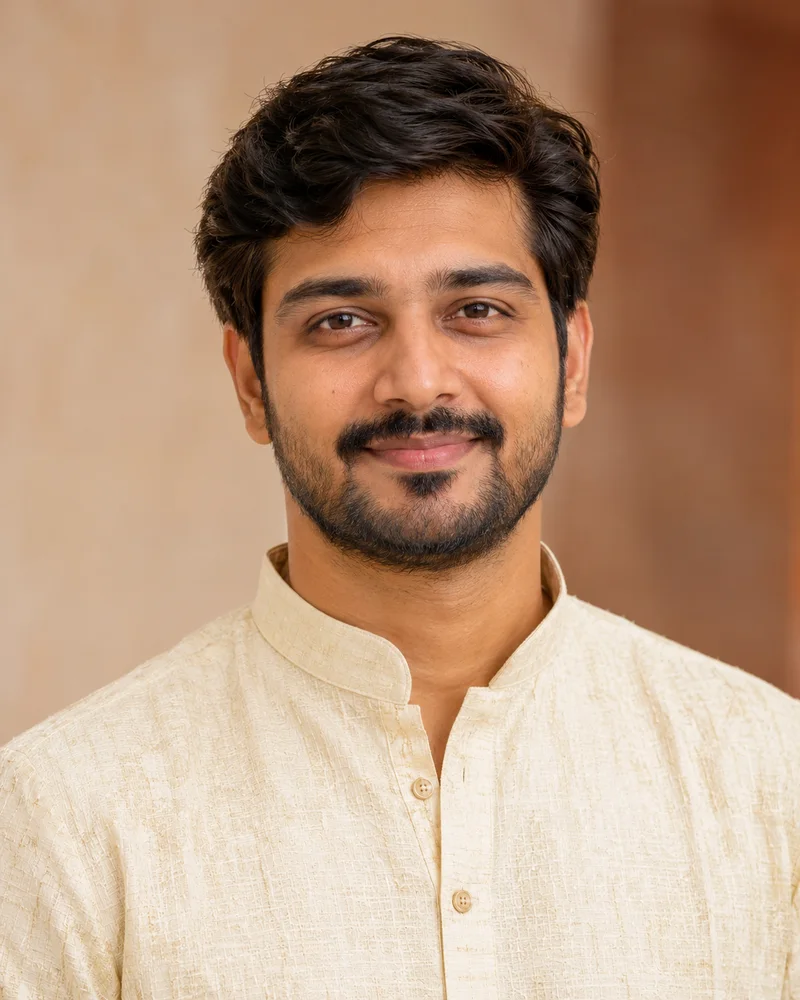
- Photo (optional): one clear, recent photo.
- Income (optional): optional; it can be written as a range or left for later discussion.
- Time of birth, rashi, gotra, caste or community (optional): only if the family uses them when looking for a match.
- Hobbies and interests (optional): two or three genuine ones.
- Partner preference (optional): one or two respectful lines.
Education and occupation wording examples
Short, specific lines are easier to read and easier to trust. Here is how the same facts read in a stronger form.
- Education: “B.Tech, Computer Science, Pune University, 2018.” Better than “Engineer.”
- Education: “MBBS, then MD (Medicine) in progress.” Say where you are in your studies.
- Occupation: “Software engineer at a product company, Pune (5 years).” Better than “Good job in IT.”
- Occupation: “Runs the family electrical-goods business in Ludhiana.” Better than “Businessman.”
- Income: “₹18 LPA” or “Prefer to discuss later.” Either is fine; never invent a figure.
Family and contact details to include safely
A groom’s biodata is also forwarded widely. Give families enough to start a conversation, and keep the rest for later.
- Name one contact person, usually a parent, with a working phone number.
- Share the city and area, not the exact home address, until both families are in serious contact.
- Do not publish Aadhaar, PAN, passport, bank or property details.
- Include parents’ and siblings’ names and occupations only; avoid listing extended relatives’ phone numbers.
- Keep health and past-relationship details out of the public biodata unless he chooses to share them.
Modern and traditional template options
Modern and clean
Light layouts that read easily on a phone screen.
Traditional and decorative
Framed designs with gold detail, popular for printed biodatas.
Concise wording examples
Say what is true, briefly. These pairs show how to replace big claims with clear facts.
| Instead of | Write |
|---|---|
| “Very good job with a high package” | “Chartered accountant at an audit firm, Chandigarh (6 years).” |
| “Well settled with own house” | “Based in Chandigarh with his family.” |
| “Handsome, tall, smart boy” | “Height 5'11" (180 cm). Enjoys cricket and cooking.” |
| “Only educated and cultured girl wanted” | “Looking for a caring partner who values family and open conversation.” |
Common mistakes to avoid
- Using big claims such as “high package” or “well settled” without a role, field or city.
- Listing a long set of conditions for the partner but very little about himself.
- Putting a parent’s or friend’s phone number without asking them first.
- Writing more than one page. A short, scannable biodata gets read; a long one gets skipped.
- Leaving out the basics that families look for first: age or date of birth, height, education, occupation and a contact name.
- Using vague words such as “good job” or “well settled” instead of the role, the field or the city.
Groom biodata format FAQ
What is the correct marriage biodata format for male candidates?
How do I write education and occupation clearly?
Should I mention income in a groom’s biodata?
Which contact details are safe to share?
Who can use this marriage biodata format for men?
Can I download the groom biodata format as a PDF?
Related pages
Published by RishteGhar · Last updated
This page was drafted with AI assistance. The advice is general guidance, not legal or professional advice.